


The B-1 visa is for business travel to the US and the B-2 visa is for individuals traveling to the US for tourism or leisure purposes. This is an important difference because they both have different requirements and application processes. The United States welcomes millions of visitors each year for business and pleasure. If you’re planning a trip to the US, understanding the difference between a B-1 and B-2 visa is crucial. These two common visitor visas cater to distinct purposes and have separate application processes. Choosing the right visa type is essential to avoid any issues at the port of entry. Applying for the wrong visa can lead to delays, denials, or even being turned away. Even though these are travel related visa, it’s is possible to obtain a green card and one day become a US citizen.
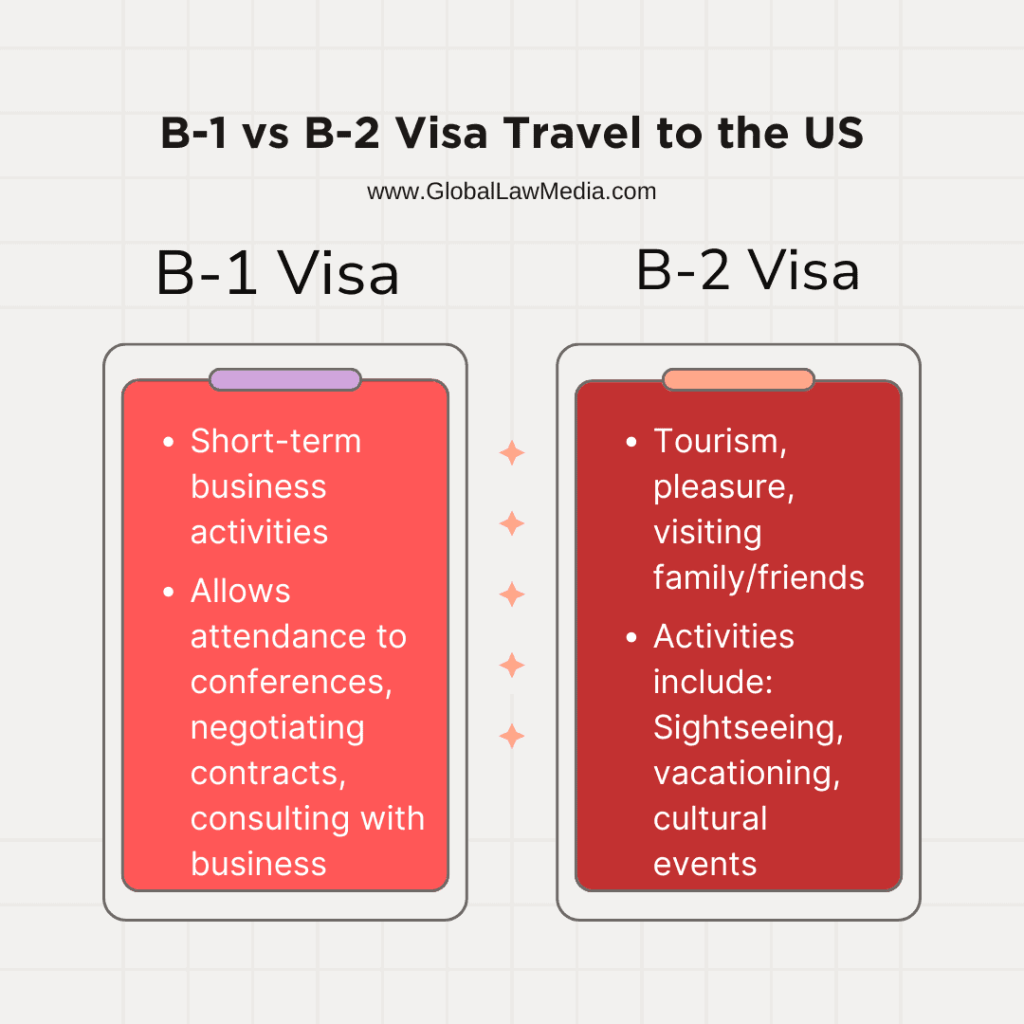
Table of Contents
What Are the B-1 and B-2 US Visitor Visas?
The B-1 visa is for business visitors, while the B-2 visa is for tourists and leisure travelers.
The B-1 Visa (Business Visitor) allows foreign citizens to engage in a variety of business activities in the US, but there are some limitations. Some common permitted activities include
- Attending conferences or business meetings
- Negotiating contracts
- Consulting with business partners
- Conducting research or training
- Participating in short-term business projects
It is Important to remember that with a B-1 visa, you cannot work for a US company or legally sell goods or services in the US.
The B-2 Visa (Tourist Visa) is best for individuals traveling to the US for pleasure purposes such as the following:
- Sightseeing and vacations
- Visiting family or friends
- Participating in cultural events or festivals
- Receiving medical treatment (with some restrictions)
- Enrolling in short-term recreational courses (not for academic credit)
However, it is important to know with a B-2 visa you can not work or accept employment in the US, study for academic credit at a US school, or participate in activities that could be perceived as business (attending business conferences, for example)
How to Apply for the Visitor Visas?
Applying for a B-1/B-2 visa involves five steps.
1. Complete Form DS-160: This is the online nonimmigrant visa application form. It gathers your biographical information, travel details, and purpose of your visit to the US. Answer all questions truthfully and accurately. It is important to correctly complete the DS-160 because a mistake on your application could delay or even prevent your visa approval.
2. Pay the US visitor visa application fee: The fee amount varies depending on your visa category, so check the current fees on the US Department of State website before making the payment. Remember, this fee is non-refundable, even if your visa application is ultimately denied.
3. Schedule your visitor visa interview: Once you’ve paid the application fee, schedule an interview appointment at a US embassy or consulate in your home country. Scheduling can be done online through the US Department of State website. Wait times for interview appointments can vary depending on your location and workload at the embassy or consulate.
4. Compile your document file for the B-1/B-2 visas: While you wait for your interview, gather the necessary documents to support your application. These documents typically include:
- A valid passport with at least six months of remaining validity beyond your intended stay in the US.
- A copy of the DS-160 confirmation page.
- Proof of payment for the visa application fee.
- A recent passport-sized photograph.
- Documentation demonstrating strong ties to your home country. This shows the US visa officer that you have compelling reasons to return home after your visit. Examples of ties to your home country could include employment, property ownership, or family ties.
- Evidence of your planned activities in the US. This might include business invitation letters for B-1 visas or travel itineraries and hotel bookings for B-2 visas.
- Financial documents showing you have sufficient funds to cover your stay in the US. The specific requirements can vary depending on your circumstances.
5. Attend your interview: Dress professionally and arrive at the embassy or consulate on time for your interview. The interview will be conducted by a US consular officer who will ask questions about your trip, your purpose for visiting the US, and your plans after your visit. Be prepared to answer these questions honestly and concisely.
Following these steps will guide you through the B-1/B-2 visa application process. The next section will address processing times and some key differences between the B-1 and B-2 visas.
How long does it take to get a B-1/B-2 visa?
It can take anywhere from a few weeks to several months to get a B-1/B-2 visa. Processing times for B-1/B-2 visa applications can vary depending on several factors, including:
- Your nationality: Citizens of some countries may experience longer wait times due to higher application volume or security checks.
- The workload at the US embassy or consulate: Embassies and consulates with a high volume of applications might have longer processing times.
- The complexity of your application: If your application requires additional scrutiny or documentation, it could take longer to process.
It is best to plan ahead and apply for your visa well in advance of your intended travel date.
How long can you stay in the US on a B-1/B-2 Visa?
You can stay in the US on a B-1/B-2 no longer than what the Customs and Border Protection (CBP) officer provides you. Unlike some visas with a set duration of stay, a B-1/B-2 visa can be a multiple entry visa. This means the visa itself allows for multiple trips to the US within its validity period. However, the authorized duration of each stay is determined by the CBP officer at the port of entry. They will grant you a specific period to stay in the US based on your itinerary and purpose of visit.
A multiple entry B-1/B-2 visa doesn’t guarantee unlimited stays in the US. CBP can deny entry.
How Many Times Can You Visit the U.S. with a B-1/B-2 Visa?
You can visit the US multiple times with a B-1/B-2 visa. A key benefit of the B-1/B-2 visa is its potential for numerous entries. This means the visa itself can be used for multiple trips to the US during its validity period. However, the duration of each stay is determined by the Customs and Border Protection (CBP) officer when you enter the country.
Here’s how it works:
- CBP Officer Grants Entry: The CBP officer at the port of entry (airport, seaport) will review your passport and visa. They will also ask questions about your trip and purpose for visiting. Based on this information, they will grant you a specific period of authorized stay in the US.
- Valid for Multiple Entries: As long as your B-1/B-2 visa remains valid, you can use it for multiple entries to the US within that validity period.
- No Guarantee of Unlimited Stays: Having a multiple entry visa doesn’t guarantee unlimited stays in the US. CBP can deny entry if they suspect you intend to stay longer than authorized or violate visa conditions.
How Much Does a B-1/B-2 Visa Cost?
The cost of a B-1/B-2 visa is $185, according to the US Department of State. The fee is typically non-refundable, even if your visa application is ultimately denied. Therefore, paying the fees doesn’t guarantee visa approval.
In addition, there may be other costs associated with the application process, such as:
- Travel to the US embassy or consulate for your interview.
- The cost of passport photos.
- Translation fees if any required documents are not in English.
What are the Requirements for a B-1 and B-2 Visa?

Obtaining a B-1/B-2 visa requires a valid passport, intent to leave the US, financial resources, and no criminal background.These criteria aim to ensure that visitors have legitimate reasons for entering the US and will depart after their authorized stay. Here’s a breakdown of some key requirements:
- Valid Passport: You must possess a valid passport from your home country that has at least six months of remaining validity beyond your intended stay in the US. A damaged or expired passport will render you ineligible.
- Completed DS-160 Application Form: This online form gathers your biographical information, travel details, and purpose of visit to the US. Fill out the form accurately and truthfully, as any inconsistencies could raise red flags for visa officers.
- Visa Application Fee Payment Receipt: Keep a copy of the receipt confirming your payment of the visa application fee. The amount can vary depending on the visa category, so be sure to check the US Department of State website for current fees.
- Nonimmigrant Intent: You must demonstrate that you have no intention of immigrating to the US. This typically involves showing strong ties to your home country, such as:
- Stable employment
- Property ownership
- Close family ties (spouse, children, parents)
- Purpose of Visit: You must have a legitimate purpose for your visit that aligns with the B-1 or B-2 visa category you’re applying for. Documentation to support your purpose of visit is crucial. For example:
- Business invitation letters (B-1 visa)
- Travel itinerary and hotel bookings (B-2 visa)
- Financial Resources: You must demonstrate sufficient financial resources to cover your expenses during your stay in the US. This could include bank statements, proof of employment, or a sponsor’s letter of financial support.
- Clean Criminal Record: A history of serious criminal offenses could lead to visa ineligibility.
Can you change status from B-1/B-2?
Yes, you can change your status from a B-1/B-2 visa, if you marry a US citizen or have a medical emergency. However, it is not advisable to enter the US with the intention of changing your visa status later. B-1/B-2 visas are specifically designed for short-term stays, and attempting to switch to a long-term visa category while in the US can be risky.
Here’s why:
- Misrepresentation: When applying for a B-1/B-2 visa, you declare your intention to return to your home country after a temporary visit. If you enter with the idea of changing status later, this could be seen as misrepresenting your initial intentions to immigration officials.
- Complex Process: Changing visa status within the US can be a complex and lengthy process. It involves filing additional applications, attending interviews, and potentially waiting months for a decision.
- No Guarantee of Approval: There’s no guarantee that your application to change status will be approved. US Citizenship and Immigration Services (USCIS) will carefully evaluate your case and may deny your request if they believe you didn’t have genuine intentions of temporary stay when entering with a B-1/B-2 visa.
However, there are some exceptions where changing status from B-1/B-2 might be possible. These situations typically involve unforeseen circumstances that necessitate a longer stay in the US. Here are a couple of examples:
- Marriage to a US Citizen: If you enter on a B-1/B-2 visa and then marry a US citizen, you may be eligible to apply for a change of status to a green card through marriage. It’s important to consult with an immigration attorney to navigate this process.
- Medical Emergency: If you experience a serious medical emergency requiring extended medical treatment in the US, you might be able to apply for a change of visa status. Documentation from a medical professional would be necessary to support such a request.
How Do I Get a B1/B2 Visa Extension?
Filing Form I-539 and receiving approval is how you get a B1/B2 Visa Extension While B-1/B-2 visas are designed for temporary stays, there might be situations where you need to extend your time in the US. Here’s what you need to know about B-1/B-2 visa extensions:
- Extension Process: Extending your B-1/B-2 visa requires filing Form I-539, Application to Change Nonimmigrant Status, with US Citizenship and Immigration Services (USCIS) before your authorized stay expires. There are associated filing fees, and USCIS approval is not guaranteed.
- Eligibility for Extension: Approval for a B-1/B-2 visa extension depends on various factors, including:
- The reason for your extension request.
- Evidence of sufficient financial resources to support your extended stay.
- Maintaining nonimmigrant intent (having no intention of immigrating to the US).
- Consult an Immigration Attorney: The extension process can be complex. Consulting with an immigration attorney is highly recommended, especially if your situation is unique or involves unforeseen circumstances.
Can I Get a Green Card With the Visitor Visas?
No, you cannot obtain a Green Card directly through a B-1/B-2 visa. However, you can get a Green Card if you have a B-1/B-2 visa if you marry a US citizen or qualify for another visa.
- Marriage to a US Citizen: If you enter on a B-1/B-2 visa and then marry a US citizen, you may be eligible to apply for a change of status to a Green Card through marriage. This process involves extensive paperwork, interviews, and background checks. Consulting with an immigration attorney is crucial for navigating this route, especially if you get a divorce after receiving your green card.
- Qualifying for another Visa Category: In some rare cases, you might enter on a B-1/B-2 visa and then discover you qualify for a different visa category that allows a path to a Green Card. This would involve applying for a change of visa status within the US, which is a complex process with a low approval rate. Again, consulting with an immigration attorney is highly recommended.
It is important to note that entering the US with the intention of later changing your visa status is generally not advisable. US immigration authorities frown upon misrepresentation of your initial intentions. It’s always best to be upfront about your purpose of visit when applying for a visa.
Can I Bring My Dependents With a B1/B2 Visa?
Yes, your dependents (spouse and unmarried children under 21) can apply for their own B-1/B-2 visas to accompany you to the US. Here’s what to keep in mind:
- Separate Applications: Each dependent needs to submit a separate B-1/B-2 visa application, even if traveling with you.
- Supporting Documentation: Include documentation supporting documentation in their application that strengthens their ties to their home country and demonstrates their purpose for visiting the US aligns with the B-1/B-2 visa category. For example, a child’s birth certificate and proof of school enrollment can be relevant.
- Separate Interview: While rare, consular officers might request separate interviews for dependents, especially older children.
Here are some additional points to consider:
- Validity Period: The visa officer might issue B-1/B-2 visas with different validity periods for you and your dependents depending on your individual circumstances.
- Traveling Separately: If you plan to travel separately from your dependents, it’s important to have a notarized letter of permission from the non-traveling parent authorizing the travel with the other parent.
- Financial Support: If your dependents are not financially independent, you’ll need to show proof of sufficient funds to cover their expenses during the stay in the US.
How will an Immigration Lawyer Help with a B1/B2 Visa?
An immigration lawyer can help you in the following ways:
- Understanding Eligibility: Immigration lawyers possess a deep understanding of B-1/B-2 visa requirements and can help you determine which visa category best suits your needs. They can analyze your situation and advise you on whether you meet the eligibility criteria.
- Completing the Application: The B-1/B-2 visa application can involve various forms and documentation. An immigration lawyer can guide you through the application process, ensuring all forms are filled out accurately and completely. They can also help you gather the necessary supporting documents to strengthen your application.
- Interview Preparation: The visa interview can be a nerve-wracking experience. An immigration lawyer can prepare you for the interview by anticipating potential questions and guiding you on how to respond effectively. They can also help you practice your interview skills to boost your confidence.
- Addressing Complexities: If your situation involves complexities, such as a criminal record or past visa denials, an immigration lawyer can offer valuable guidance. They can help you navigate these challenges and present your case in the most favorable light.
- Denial Representation: If your B-1/B-2 visa application is denied, an immigration lawyer can represent you in appealing the decision. They understand the appeals process and can increase your chances of a successful outcome.
The B-1/B-2 visa application process can sometimes be complex, especially if your situation involves unique circumstances. Consulting with an immigration lawyer doesn’t guarantee visa approval. However, their expertise can significantly improve your chances of a smooth and successful application process.
Do I Need to Obtain Health Insurance as a Visitor in the United States?
No, health insurance is not mandatory for obtaining a B-1/B-2 visa. However, having health insurance is strongly recommended for visitors to the United States. Here’s why:
- High Medical Costs: Medical care in the US is very expensive. Even a minor illness or injury can result in significant medical bills. Health insurance can help protect you from financial hardship in case of an unexpected medical emergency.
- Limited Coverage by Travel Insurance: Travel insurance often excludes pre-existing medical conditions or specific types of emergencies. It’s crucial to carefully review your travel insurance policy to understand its limitations.
- Peace of Mind: Having health insurance can provide peace of mind during your visit. Knowing you’re covered for medical expenses allows you to relax and enjoy your trip without worrying about unforeseen medical costs.
What are the Types of Health Insurance for Visitors:
There are two main types of health insurance options for visitors to the United States:
- Travel Medical Insurance: These short-term insurance plans are specifically designed for visitors and can cover medical expenses incurred during your trip. Premiums vary depending on the plan’s coverage, your age, and the length of your stay.
- Comprehensive Medical Insurance: If you’ll be visiting the US for an extended period, you might consider purchasing a comprehensive medical insurance plan. These plans offer broader coverage but typically come with higher premiums.
How to Choose the Right Health Insurance?
When selecting a health insurance plan for your US visit, consider the following factors:
- Length of Stay: The longer your trip, the more comprehensive coverage you might need.
- Activities: If you plan on engaging in adventurous activities, ensure your plan covers potential injuries.
- Pre-existing Conditions: Choose a plan that covers pre-existing medical conditions if applicable.
- Budget: Compare plans and premiums to find one that fits your budget.
It will be important to carefully review the terms, exclusions, and limitations of any health insurance plan before purchasing it. By obtaining health insurance, you can safeguard yourself from financial burdens and enjoy your US visit with greater peace of mind.
Do I Need to Obtain Travel Insurance before Coming to the United States?
No, you do not need to obtain travel insurance before coming to the US and for a B-1/B-2 visa. However, travel insurance is a valuable consideration for visitors to the United States. Here’s a breakdown of the pros and cons to help you decide:
What are the Benefits of Travel Insurance?
- Trip Cancellation Coverage: Travel insurance can reimburse you for prepaid trip expenses (flights, hotels) if you’re forced to cancel your trip due to a covered reason, such as illness, injury, or natural disasters.
- Trip Interruption Coverage: If your trip is interrupted due to a covered reason, travel insurance can help cover expenses to return home and resume your trip later.
- Medical Expense Coverage: Some travel insurance plans offer supplemental medical expense coverage, which can be beneficial if your health insurance has limited coverage in the US.
- Baggage Loss or Delay Coverage: Travel insurance can reimburse you for lost, stolen, or delayed baggage, helping you replace essential items.
- Travel Assistance Services: Many travel insurance plans offer 24/7 assistance services, providing help with things like finding medical care, replacing lost travel documents, or arranging emergency transportation.
What Things Does Travel Insurance Don’t Cover?
- Pre-existing Medical Conditions: Most travel insurance plans exclude coverage for pre-existing medical conditions.
- Certain Activities: Travel insurance might not cover injuries sustained during high-risk activities like extreme sports.
- Change of Mind: Travel insurance typically doesn’t cover cancellations or trip interruptions due to a change of plans on your end.
The decision to purchase travel insurance depends on your individual circumstances and risk tolerance. Here are some factors to consider:
- Value of Your Trip: If your trip involves expensive flights, hotels, and pre-paid activities, travel insurance can provide valuable financial protection in case of cancellation.
- Your Health: If you have any pre-existing medical conditions, travel insurance with supplemental medical coverage might be wise.
- Your Risk Tolerance: If you’re worried about unexpected events disrupting your trip, travel insurance can offer peace of mind.
Travel insurance premiums can vary depending on the coverage you choose, the length of your trip, and your age. It’s always best to compare plans and prices from different providers before making a decision.
How Does the Electronic Visa Update System (EVUS) Apply to Visiting the US?
The Electronic Visa Update System (EVUS) is an online system that applies to nationals of certain countries holding B-1/B-2 visas that are entering the United States. The EVUS is mandatory for travelers holding a valid 10-year B1/B2, B1, or B2 visa issued by the US Department of State and who are nationals of certain countries participating in the Visa Waiver Program (VWP).
What is the Visa Waiver Program (VWP)?
The VWP allows citizens from certain countries to travel to the US for short stays (up to 90 days) without obtaining a visa. However, travelers from VWP countries who hold a B1/B2, B1, or B2 visa still need to enroll in EVUS before their trip.
How Does EVUS Work?
The EVUS enrollment process involves creating an online account and providing basic information, including passport details, travel itinerary, and contact information.
Benefits of Enrolling in EVUS:
- Faster Entry Process: Having a valid EVUS enrollment can expedite your entry process at US Customs and Border Protection (CBP).
- Travel Authorization Confirmation: A successful EVUS enrollment provides confirmation that you’re authorized to travel to the US under the VWP with your B1/B2, B1, or B2 visa.
Important to Remember:
- Validity Period: An EVUS enrollment is generally valid for two years or until your visa expires, whichever comes first. You’ll need to re-enroll in EVUS if you obtain a new visa or your existing enrollment expires.
- Not a Guarantee of Entry: A valid EVUS enrollment doesn’t guarantee automatic entry into the US. The final decision on entry rests with the CBP officer at the port of entry.

By understanding the EVUS requirements, you can ensure a smooth travel experience when visiting the US under the VWP with your B1/B2, B1, or B2 visa.
How Does the NAFTA and USMCA Treaty Apply to Visiting the US?
The North American Free Trade Agreement (NAFTA), now superseded by the United States-Mexico-Canada Agreement (USMCA), no longer directly applies to visa requirements for short-term business travel to the US.
However, there are some residual effects of NAFTA, and the USMCA offers similar benefits for business travel between the three countries (US, Mexico, and Canada).
USMCA and Professional Visas
The USMCA doesn’t have a direct equivalent to the TN visa. However, citizens from Canada and Mexico can still apply for other professional visas, such as the H-1B visa for specialty occupations, to work temporarily in the US.
Benefits for Business Travelers
The USMCA promotes business travel between the US, Canada, and Mexico by:
- Streamlining business travel procedures: This can involve simplifying border crossings and expediting entry processes for business travelers.
- Encouraging short-term business visits: The USMCA acknowledges the importance of facilitating short-term cross-border business activities.
Important to Remember:
- Citizens from Canada and Mexico still require visas: Even with the USMCA, Canadian and Mexican citizens typically need a visa to work in the US, depending on the nature and duration of their business activities.
- Consult an Immigration Lawyer: The US immigration system can be complex. If you’re a business person from Canada or Mexico planning to travel to the US for work purposes, consulting with an immigration lawyer is highly recommended. They can advise you on the appropriate visa category and ensure you meet the eligibility requirements.
While the NAFTA TN visa is no longer available, the USMCA maintains a focus on facilitating business travel between the three North American countries. However, always check current visa requirements and consult with an immigration lawyer for specific business travel needs.
Frequently Asked Questions (FAQs) about B-1 and B-2 Visas
Q: Can I apply for a B-1/B-2 visa online?
A: Yes, you can apply for a B-1/B-2 visa by completing the DS-160 application form online. However, a face-to-face interview at a US embassy or consulate in your home country remains mandatory.
Q: How long do I have to wait for a B-1/B-2 visa interview?
A: Wait times for interview appointments can vary depending on your location and the workload at the US embassy or consulate.
Q: How long can I stay in the US on a B-1/B-2 visa?
A: The validity period of a B-1/B-2 visa can vary depending on your application, the purpose of your visit, and the decision of the consular officer. They can be issued for multiple entries and can range from a few months to several years.
Q: Can I extend my stay in the US on a B-1/B-2 visa?
A: There’s a possibility, but it requires filing an application with USCIS before your authorized stay expires. Approval for extension is not guaranteed.
Q: Can I work in the US on a B-1/B-2 visa?
A: No. Working for a US company or receiving payment from a US source is strictly prohibited on a B-1/B-2 visa.
Q: Should I bring a sponsor letter for my B-1/B2 visa application?
A: In some cases, a sponsor letter demonstrating financial support can strengthen your application, especially if you have limited funds. However, it’s not mandatory for all situations. Consult with an immigration lawyer for specific guidance.
Q: Should I hire an immigration lawyer to help with my B-1/B-2 visa application?
A: While not mandatory, consulting with an immigration lawyer can be beneficial, especially if your situation is complex or you have any concerns about eligibility. An immigration lawyer can provide guidance throughout the application process and represent you if needed during the interview.
Q: What happens if my B-1/B-2 visa application is denied?
A: If your visa application is denied, you will receive a notification explaining the reason for denial. You can reapply for the visa, but you’ll need to address the reasons for the previous denial in your new application.
Final Words
Planning a trip to the United States can be exciting, and understanding the visa process is crucial for a smooth experience. Whether you’re a business person attending a conference (B-1) or a tourist visiting family (B-2), the B-1/B-2 visa can be your gateway to exploring the US.
Key Takeaways:
- The B-1 visa is for short-term business activities, while the B-2 visa is for tourism and pleasure.
- Carefully consider your trip’s purpose to choose the right visa category.
- Consulting an immigration lawyer can be beneficial for a complex application or unique circumstances.
- Consider health insurance and travel insurance for added peace of mind during your visit.
- Be aware of EVUS requirements if you’re traveling from a VWP country with a B1/B2, B1, or B2 visa.
- The USMCA facilitates business travel between the US, Canada, and Mexico, but visa requirements still apply.
By understanding the information presented in this comprehensive guide, you can approach the B-1/B-2 visa application process with more confidence. Remember, thorough preparation and adherence to visa regulations will increase your chances of a successful application and a memorable US visit.

